

Executive Coaching ROI
Most organizations evaluate the cost of coaching. Very few evaluate the cost of not coaching.
That second number is harder to see, which is why it rarely gets counted. It is also, for most chief executives, the larger one.
Start with the Arithmetic
Take a leader compensated at $1M who influences $50M in revenue. That influence isn’t a metaphor. It is the portfolio of decisions running through one person: what gets built, who gets hired, which bets get funded, which get killed, and how fast the organization can move when conditions change.
Now assume coaching produces a moderate lift in that leader’s effectiveness. Not a transformation. Five to ten percent.
Five to ten percent of $50M is $2.5M to $5M in enterprise value, before compounding.
Against that, the fee is a rounding error. So the real question was never whether the fee is justified. It is whether the lift is real.
The Evidence on Whether the Lift is Real
It is — and the research is more specific than this category’s marketing usually admits.
A 2023 meta-analysis in Frontiers in Psychology pooled twenty randomized controlled trials of coaching, the study design that actually isolates cause from correlation. It found consistent, meaningful gains. The most useful finding was in the distribution: behavioral improvements came through nearly twice as strong as changes in attitude.
That distinction is the whole thing. Attitude change feels like progress and produces very little. Behavior is what moves enterprise value, because behavior is what the organization actually experiences.
Which is why the work goes at beliefs rather than behaviors directly. Change beliefs to change behaviors. Tell a leader to delegate more and you get a week of delegation. Change what a leader believes about being needed, and the delegation holds.
What it is Not
It is not therapy, and the confusion costs the category real credibility.
Coaching isn’t designed to fix people. It is built for high performers who want to climb faster. The most decorated Olympian in history still has a coach — not because he is drowning, but because he wants to swim faster. The coach does not out-swim the athlete. The coach accesses and accelerates the capacity already there.
The power isn’t fixing weakness. It’s increasing capacity. Those are different products with different returns, and only one of them is worth several million dollars.
Where the Return Actually Comes From
Here is the pattern behind most chief executives who feel busy and stuck at the same time.
The leader either has the business, or the business has the leader. There is no third state.
A leader’s real job is to design the system the business runs on, then step out of it so the system can run. Being load-bearing feels like strength. It is a structural flaw. Scale punishes mechanisms.
You can read it straight off a calendar: the meetings only you can chair are the architecture you never drew. Or run the two-week test — pull yourself out of the calendar for two weeks and watch which parts of the structure sag.
Every hour spent being the mechanism is an hour not spent being the architect, and the architecture is the only part of the job that compounds. Multiply that gap across a year and you have the cost of not coaching. It never appears as a line item. It appears as a company that cannot move faster than one person.
Diagnose Before You Intervene
The reason most leadership development returns nothing is that it intervenes before it diagnoses. It arrives with a workshop already in hand.
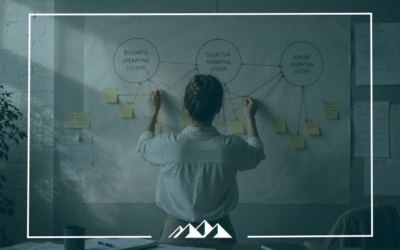
Three systems run every company — the Business Operating System (BOS™), the Collective Operating System (COS™), and the Human Operating System (HOS™) — under one rule: no system may solve a problem that belongs to another. The real enemy is substitution. When one system is underpowered, the others work overtime to compensate. Effort rises and impact falls, which is precisely what busy-and-stuck feels like from the inside.
A rough diagnostic. If the plan is clear but behavior is reactive, that is Human. If meetings feel good but follow-through collapses, that is Collective. If you cannot scale, or priorities keep colliding, that is Business.
Intervening in the wrong one is how organizations spend real money and change nothing.
What Clients Said the Return Was
“Adjusting my leadership style to ask more and tell less, we saved $1M in the first year. That’s a successful ROI.” — Larry Oeffinger, former Director of IT, Genentech
“Since 2021, our revenue has grown 55.1% — and I’m a fundamentally stronger leader.” — Kelly Veit, CEO, Veit Construction
Neither of those is an attitude change.
Where to Start
If any of this is recognizable — the calendar full of meetings only you can chair, the plan that is clear, and the follow-through that isn’t — the useful next step is not a program. It is one conversation to work out which of the three systems is actually carrying the problem.
That conversation costs nothing and it is not a sales call. Start that conversation here.
More on how we work with chief executives: CEO coaching. The full argument, with the research and the models: Why Every CEO Needs a Coach — Architect, Not Mechanism.
Reach your next peak.