

I work with a lot of family businesses, and every family business carries two things into the future: what built it, and what will break it. So where do family businesses get stuck?
The founder’s instincts, values, and operating style created something real—a company that employs people, serves customers, and sustains a family. That legacy deserves respect. But legacy, unchecked, becomes a cage. And the moment succession enters the picture, the tension between honoring the past and building the future stops being philosophical and becomes operational.
Founders focus on preservation. Next-gen leaders push for relevance. Neither is wrong. But without alignment, the business doesn’t move forward or backward. It just gets stuck.
The Symptoms Everyone Recognizes
You’ve seen where family businesses get stuck. Maybe you’re living it right now.
Senior leadership resists new ideas, not out of stubbornness, but out of loyalty to what worked. The next generation brings energy and modern thinking, but their initiatives stall, get watered down, or get quietly overridden. Decision-making slows to a crawl because the people in the room aren’t disagreeing about tactics—they’re disagreeing about what the business should become.
Innovation gets proposed, debated, tabled, and forgotten. Not because anyone said “no”. Because no one could say “yes” with enough authority to make it stick.
The frustration is real on both sides. Founders feel their life’s work is being dismissed. Successors feel their future is being held hostage.
And the business? The business pays the price in lost momentum, lost talent, and lost time.
Why This Isn’t Really About Tradition
Here’s the part most families miss: the conflict between tradition and transformation is really a symptom, not the problem itself.
The real problem is architectural.
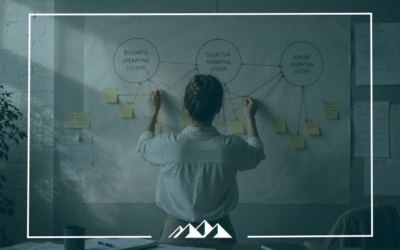
At CO2 Coaching, we work with our proprietary framework called the TRIAD Operating Architecture™, a way of understanding the three systems that every organization runs, whether they’ve named them or not:
- The Business Operating System (BOS™) governs how results are produced—strategy, structure, decision rights, metrics, cadence, and resource allocation. It’s the visible machine of execution.
- The Collective Operating System (COS™) governs how people coordinate—how decisions are made and held, how conflict is handled, how commitments become real, and how accountability actually works between people. It’s the social circuitry.
- The Human Operating System (HOS™) governs how individuals generate behavior—attention, sensemaking, emotional regulation, identity, and the capacity to lead under pressure. It’s the inner code.
When a family businesses get stuck between tradition and transformation, the instinct is to treat it as a strategy disagreement (BOS) or a personality clash (HOS). What’s said inside the company is that more communication is needed (“We just need to get on the same page“) or more process (“Let’s re-write the strategic plan“). But those interventions often fail because they’re aimed at the wrong system.
Most of the time, the real breakdown lives in the space between people—in COS, the coordination system.

Where Family Businesses Get Stuck
Think about what happens in the typical succession tension:
Decisions don’t hold. The founder and successor agree on a direction in a meeting, but execution drifts. People check with the old power center. The successor’s authority is technically real but practically fragile. This is a COS failure—decision norms haven’t been rebuilt for the new authority structure.
Conflict goes underground. No one wants to disrespect the founder. No one wants to seem ungrateful. So, disagreements get expressed sideways through delays, workarounds, and hallway conversations. This creates a real coordination problem. The leadership team and the employees don’t have pathways for productive conflict under the new reality.
Innovation stalls not because ideas are bad, but because the system can’t process them. When decision rights are ambiguous, when the founder’s implicit veto still operates, when the organization hasn’t clarified how new ideas get evaluated and resourced—good proposals die in limbo. That’s an execution architecture (BOS) that hasn’t been updated for the transition rather than resistance to change.
Leaders hesitate. Key executives watch the tension between generations and hedge their bets. They don’t fully commit to the successor’s vision because they’re not sure it will stick. They don’t push back on the founder because the political cost is too high, which is a rational response to an ambiguous system. And it’s a signal that HOS—the capacity to lead through uncertainty—needs development.
The Trap: Solving the Problem in the Wrong System
Here’s where family businesses get stuck and make the most expensive mistake: they try to fix the problem, but they fix it in the wrong system.
They add more process, more meetings, more strategic planning, tightening BOS when the real issue is that people can’t coordinate honestly. They send the next-gen leader to an executive program, investing in HOS when the real issue is that decision rights haven’t shifted. They hire a family business consultant to facilitate better communication, working on COS when the real issue is that the strategy itself hasn’t been updated to reflect the market the successor will actually face.
The TRIAD’s core discipline is simple: diagnose first, then solve the problem where it belongs. No system is allowed to solve problems that belong to another system.
That single constraint prevents the most common and costly error in succession—throwing effort at the wrong layer.
What Alignment Actually Looks Like
When the three systems develop together during succession, the shift is tangible:
- Decisions hold after the meeting. The successor’s voice carries authority not because the founder stepped aside, but because the organization’s coordination systems—decision norms, commitment practices, accountability structures—have been rebuilt to support it.
- Conflict becomes faster and less personal. Disagreements between generations get surfaced, worked, and resolved through clear pathways instead of festering in backchannels.
- Innovation gets a fair hearing. Not because the founder stopped caring about tradition, but because the business has a clear process for evaluating new ideas against strategic priorities, and the successor has the decision rights to act.
- Leaders stop hedging. When authority is clear, coordination is real, and leadership capacity matches the complexity of the transition, the executive team stops waiting for permission and starts executing.
The Question That Unlocks Movement
If your family businesses get stuck between tradition and transformation, resist the urge to pick a side. Instead, ask the diagnostic question:
Is this a results problem, a coordination problem, or a capacity problem?
- If execution can’t scale and priorities collide: That’s BOS. Fix the machine. Clarify who actually has the authority to make the call.
- If meetings feel good but follow-through collapses: That’s COS. Strengthen the circuitry. Are commitments explicit, or are we assuming agreement because we’re related?
- If the plan is clear but the leader is reactive or avoiding conflict: That’s HOS. Expand the inner code. Are leaders hanging onto old identities? Or struggling under the weight of the transition?
The discipline is to solve the problem where it lives, not where it’s most comfortable to work.
Legacy Isn’t a Prison
Family businesses get stuck when they don’t coordinate their future, not because they honor their past.
The tension between tradition and transformation is real, but it doesn’t have to be paralyzing. When the systems underneath the business—the machine, the circuitry, and the code—develop together, legacy becomes a foundation instead of a constraint.
That’s the work. Not choosing between the founder’s vision and the successor’s ambition, but building the architecture that lets both contribute to what comes next.
Often the block traces back to the founder identity crisis underneath it, and getting unstuck starts with a 90-day plan, not another conversation.